
You Either Love It Or Hate It
Sea Fishing Lures. Learning how to catch sea bass with lures can be one of the most exhilarating outdoor sports in the UK or anywhere in the world. If you’re a fisherman, that is. But let’s face it, if you’re not into fishing, then none of this will make any sense. People have compared fishing to Marmite; you either love it or hate it.

Hard Work
Lure fishing can be hard work, but it can be sheer pandemonium when you get things right. Unfortunately, those days are not always on the cards, so you need to know you are doing things right from the off.
Sea Fishing Lures – The Right Tactics
Like any sporting pastime, normally, you are going to get what you pay for. So don’t worry; there are no affiliate links on this page; we are not promoting products. Sometimes, though, having the ‘better gear’ for some things can be a great help. Besides, there are loads of other pages on this website that can point you in the right direction as far as equipment goes.
Here is a list of things you can consider before we start chucking lures out into that sea.
- Safety First guys
- Weather Forecast
- The right fishing gear
- Good selection of lures
- Where to Fish
- Fishing Tactics
Safety First Guys
Yes, you need to be very careful about lure fishing if you have experienced some of the close shaves I have had in the past. Don’t worry; I’m not going to go into my history of mistakes fishing because, honestly, I’m not particularly eager to take any dangerous risk, even though I have. However, sometimes my colleague will go that extra mile to get into the fish. With that being said, he has years of experience under his belt. So what I’m trying to say is that you can still definitely catch bass without being a hero and not taking any unnecessary risks.
The Dangers: Wading In The Water
Wading through the water can be a treacherous affair if you are not careful, especially if you are wading over slippery rocks covered in seaweed or through gullies where the water can get deeper if you slip into one. I have taken a tumble on a couple of occasions, believe me, it’s not nice. So my advice would be to at least get yourself a decent pair of wading boots if venturing in the water and climbing rocks.
Wear a Life Jacket
If you don’t have a life jacket and you are in the water, this is a no-brainer as far as I’m concerned. I mean, you don’t have to have one of those great big orange/yellow things they had back in the dark ages that you can see from ten miles away; jeez, we don’t want to frighten the fish off. The best advice is to check out what fisherman are using on their kayaks. Or check out our post on life jackets. Some of the more expensive lure vests have a built-in life jacket, so they may be worth a look. Daiwa and IMA are both perfect lure vests.
You Need To Stay Dry: Check The Weather
So some fishermen will fish in all sorts of bleak weather scenarios. For me, there is nothing worse than getting drenched by a power shower and not having a decent waterproof coat. But, of course, if we are wearing waders, most of us should be dry anyway, but you would still need a coat.
One summer, my friend and I drove to a fishing location off Herne Bay. It had been a belter of a hot day, not a cloud in sight. As we drew closer to the venue, I noticed this black shadow ahead of us. Surely it wasn’t going to rain. Well, you guessed it, it poured it down from start to finish. I was none too pleased.
Lesson learned: Check the weather and have the right weather clothing just in case. Even if it’s just a plastic raincoat or a waterproof cagoule when it’s been a scorcher of a day, we may not want a heavy coat, not in the summer anyway.
The Right Fishing Gear
Here is a checklist of things you will need for lure fishing
- Lure Rod
- Fishing Reel
- Braid
- Fluorocarbon carbon leader (optional)
- Lure clips
- Braid Scissors
- Pliers
- Fish grips (optional)
- Headlight (if night fishing)
- Selection of lures
- Lure box
- Lure vest or rucksack
There may be items that are not on the list; this is the bare minimum.
Good selection of lures
My favourite topic. Now I could go on and on about lures, but we cover lures on other parts of our website, so follow the links at the bottom of this section. Some of the lures I mention, I will always have with me for a good reason: I know they work.
To get you off to a good start
Sometimes, occasionally, you could chuck anything out there and catch a bass. When everything comes together, i.e. weather, tides, and finding a massive shoal of bass, we know we will catch. Unfortunately, these days are not always going to be realistic.
One night, while my buddy and I were fishing off the prom with live prawns, this bloke turned up on his pushbike. Now I decided to give this live prawn a go because, unfortunately, my friend didn’t want to lure fish off the rocks because of an accident he had. He wasn’t perfect on his feet. A wise move, YOU DO NOT WANT TO FALL OVER IN THE WATER OR ON THE ROCKS, especially if you’re a bit unsteady.
Flounder First Cast
I was amazed, to be honest, he had a flounder first cast, then another, and then a small schoolie. But what grabbed my attention was this bloke who arrived on a bike about twenty yards away. He was hoofing out the bass. Not all slabs, but averaging around the 2-pound mark, one after the other.
Now I am not one to judge, but some of my lure knowledge and tactics were thrown up in the air, this bloke was surely taking the mickey. My point is that night, a huge shoal just turned up and was scoffing at everything that moved.
Broom Handle
This bloke had a broom handle of a rod and a reel the size of a truck and mono that looked like rope. Oh, I haven’t even mentioned the spinner yet; that was like a metal dustbin lid. Alright, I am exaggerating a tad, but my point is when it’s on, it’s on.
I think he ended up with 16 bass in total, but that was still better than my best at that time (not anymore). Incidentally, some more experienced anglers will do these numbers all the time. They will keep moving till they find the fish (if they’re not catching).
Best Bass Lures I Would Use If I Had Just Started (Bare Minimum)
2 x Top Water lures
1: Tackle House Vulture (White)

2: Xhorus Baby Patchinko 500G

2 x Sub Surface
1:Komomo II (Mullet)

2: Daiwa Shoreline Shiner R50+SSR MagmaSardine

2 x Mid Water
1: Megabass Zonk SW 120 (Pearl)

2:Maria Squash

2 x Soft Plastics
1: Savage Gear Eel (Lemon Back)

2: Fiish Minnow (White Red Head)

Weedless Lures
1: Albie Snax
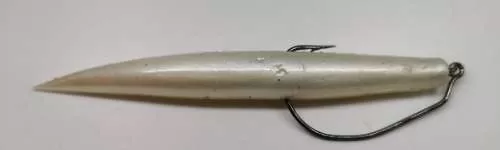
2: Pirate Seducer

Metals
Abu Toby

2: Savage Gear Seeker

What Brand Of Lure Should I Buy?
There are literally loads of different brands of lures to choose from. A lot of the patterns are copied and sold at a much lower price, like on AliExpress. Whether or not you choose to go down the cheap and nasty route is totally up to you. In some cases, the copies can look identical, and there is nothing to say that they don’t work. But as in most things, you get what you pay for…simple.
Comparison
One of my favourite lures (which can be a nightmare to get hold of) is the IMA Sasuke Sandbora 120mm. Amazingly, I love this lure simply because it has held up on several occasions when the fishing has been slow. However, while I was looking on AliExpress, I came across this lure that looked exactly like the Sandbora, but the price was less than a fiver. So I ordered it, then waited a month for the lures (I bought two) to turn up to make my comparison.
The Bottom Line
Ultimately, the difference between the two (to the naked eye) wasn’t so obvious; they looked pretty much the same. For Example, they look different in the picture because my original Sandbora has been chewed to bits. But what I noticed was the density between the two. The copy was much lighter in comparison.
Don’t Waste Money On Cheap Copies
Yes, get the brand name, and at least you will know you have the real deal. Sometimes, a lot of research goes into manufacturing these lures simply because they want them to work, and the competition must be immense.
Where Are The Best Places To Fish
My best advice to an absolute newbie would be to go to the local tackle shop and ask. This is a no-brainer as far as I’m concerned. But if you have an incline about bass and their food source, you will probably work out they could potentially be everywhere.
In The Real World
Yes, in the real world, life isn’t always as straightforward, especially when catching bass. But, if there is clear water and rocks and some good tide, you should be good to go.
Google Earth
Google Earth is another great way to see what the coastline looks like and places where there could be bass. Without knowing where you live, it’s hard to explain where to go. Sorry, you’re going to have to figure it out for yourself. Just don’t give up.
Bass Guides
I know that some people wanting to learn bass fishing will pay for a guide. There are definitely guides down the West Country but how much they cost is another ball game; I wouldn’t know.
Fishing Tactic
Right, let’s keep this simple: you are going to have to find the fish. If you are absolutely on your own, you are going to have to be patient. As I have mentioned before: If there ain’t no fish, you’re not going to catch. It’s that simple. I would recommend keeping a diary of the following:
- What time of day are you fishing
- Water clarity (Some of the clarity can change with the state of the tide)
- Tide, from low to high water
- How big is the tide?
- Building Tides
- Wind direction
- Wind Strength
Click this link to read how the tides work
Now That Your Fishing
Right, let’s catch some fish. Okay, so we have found what we think is a great place to catch bass. The conditions are great, the tide is running, and there is some activity in the water. There could be birds diving or fish chasing baitfish, all good signs that there could be bass about. So if you know there is a good chance the fish are there, then you can keep changing your lure(every ten casts) till you get a take. That’s Tactic One.
Tactic Two: It is to have twenty or so casts and then move to another spot. But fan out where you are casting so you are covering as much ground as possible. We always try to find the fish when we go lure fishing; this is normal. Rarely do we turn up and bang; we get a fish first cast.
Sometimes I have fished for hours, and I mean hours and caught nothing. Then just as we decide to call it a day, bang…FISH ON!

- Red Dots: This indicates where you would be fishing, moving from 1 through to 5. Having 20 or so casts on each spot.
- Yellow Arrows: This indicates the direction of casting from left to right in this scenario.
- Blue Arrow: This indicates the tide direction. In this case, the tide is running from left to right, meaning the tide is going out; it’s on the ebb. If the tide runs from right to left, it shows a flooding tide.


